Creator Economy
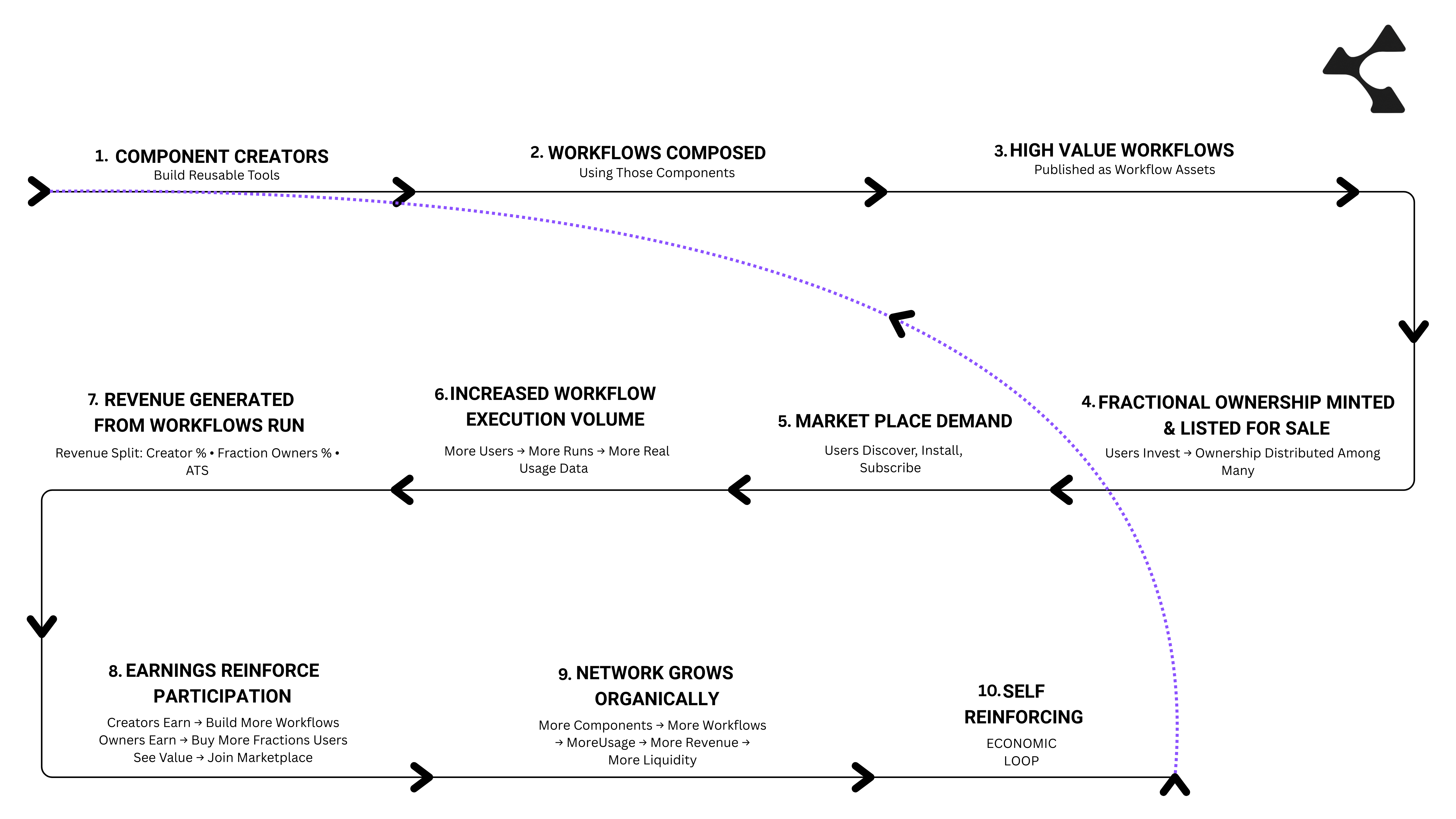
Agents Trail introduces a new economic primitive where automation itself becomes a monetizable digital asset. Instead of workflows existing as static, local scripts, each automation created in Agents Trail is published into an on-chain verifiable assets, enabling creators to distribute, monetize, and grow the value of their work across the network.
The Creator Economy transforms workflows from “tools people use” into programmable income-generating assets.
When a user completes a workflow, user converts it into an Automation Asset — a uniquely identifiable, versioned entity with:
- creator identity
- execution metadata
- performance scores
- reliability metrics
- usage lineage
- upgrade history
Rather than merely exporting a JSON file or sharing a template link, creators publish a verifiable automation that carries economic rights.
This ensures that creators retain authorship and receive long-term rewards as their workflows gain traction.
Built into the protocol is a fractionalization engine that enables creators to split the economic rights of their workflow into programmable shares. These shares represent:
- partial ownership
- entitlement to revenue
- exposure to workflow performance
- long-term upside of adoption
Fractional ownership unlocks new incentive structures:
- Creators can raise liquidity on their automations.
- Contributors can invest in workflows they believe will scale.
- High-performing automations can distribute value to multiple stakeholders.
Fractionalization turns workflows into community-backed micro-protocols, not isolated tools.
Every time a workflow runs, it generates a protocol-level execution fee. This fee is automatically distributed via the value routing system to:
- the original creator
- fractional owners
- component creators (if used)
- the protocol infrastructure
This creates a transparent, verifiable value flow where every contributor to an automation’s functionality participates in its success.
Automation becomes a shared economic activity, not a closed SaaS feature.
Agents Trail extends the creator economy to developers by enabling component authors to publish custom-coded components as monetizable assets.
If a workflow uses a developer’s component, a portion of the execution revenue is routed to the component creator — creating a full-stack economic model where:
- beginners create workflows
- engineers create components
- both earn recurring revenue
Developers no longer publish for free. Components become earning primitives inside the ecosystem.
Agents Trail includes an intelligent discovery layer where users can explore automation assets ranked by:
- usage frequency
- reliability
- creator reputation
- execution cost
- performance score
- trending velocity
This is not a traditional “marketplace”; it is a reputation-driven intelligence graph where users can identify top-performing automations and components, invest in them, or deploy them instantly.
This promotes a meritocratic ecosystem where the best automations naturally rise to the top.
The Creator Economy aligns incentives across all participants:
- Creators earn from their automation assets.
- Investors earn from fractions.
- Developers earn from modular components.
- Organizations reduce operational cost with automated systems.
- The protocol gains volume and liquidity from execution.
Every actor contributes to the growth of the automation network, creating a self-reinforcing flywheel where value compounds as adoption grows.
For the first time, automation is treated as:
- an asset class
- an investable technology
- a yield-producing system
- a creator-driven economy
- a programmable intelligence network
Agents Trail does for automation what NFTs did for digital art and what DeFi did for financial primitives, it transforms an entire category into a permissionless, monetizable, composable ecosystem.